

Epoxy Flakes Flooring Dubai: Durable, Decorative Coatings Built for UAE Homes & Businesses
If you’ve been searching “epoxy flooring Dubai,” chances are you’ve hit a wall of pages that talk about ten different flooring systems at once and mention flakes as a side note. That’s not what this page is. We install flake epoxy floors specifically, and this is everything you need to know before you commit — what the flakes actually do, what they cost, and why they hold up so well in this climate.
What Is Epoxy Flakes Flooring?
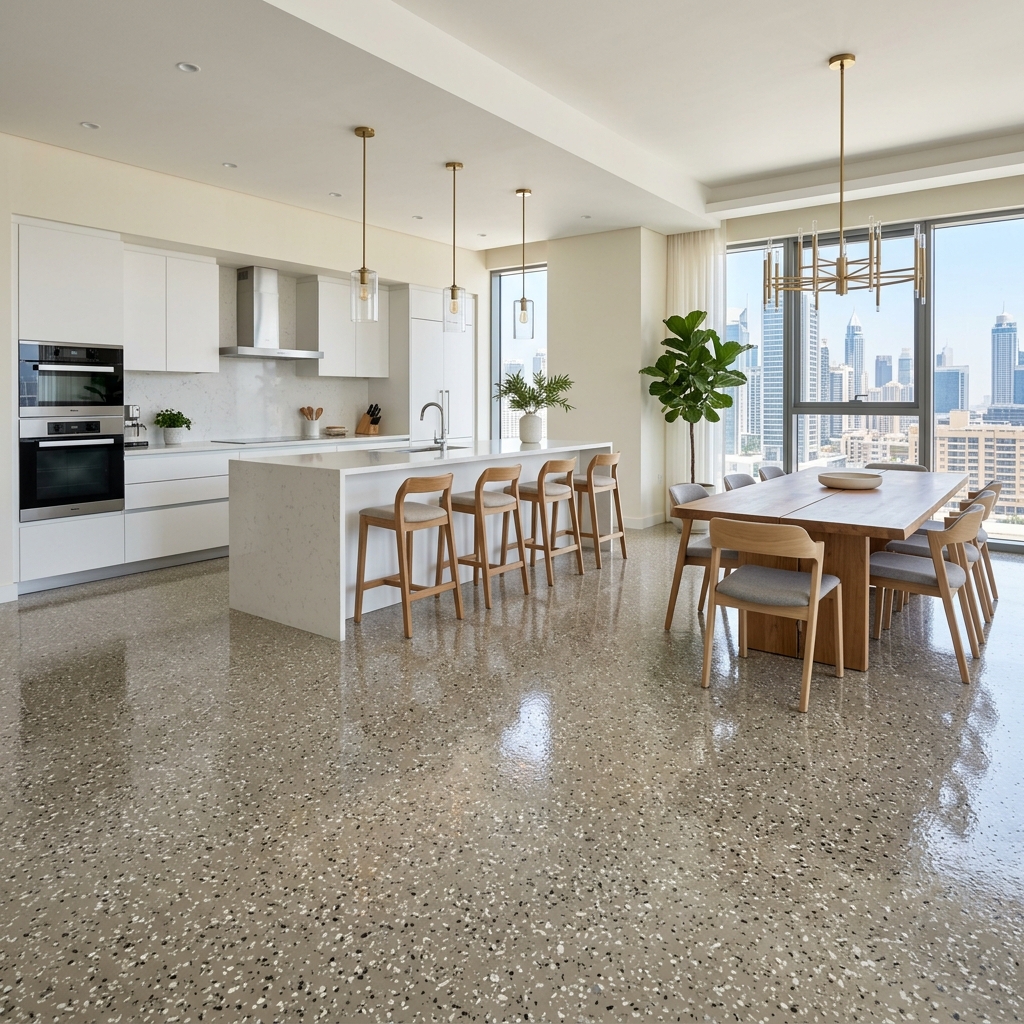
Epoxy flake flooring starts the same way any epoxy system does — a resin and hardener mixed and rolled onto a properly prepped concrete surface. The difference is what happens next: while that base coat is still workable, we broadcast decorative vinyl or acrylic chips across it by hand. Once it cures, we seal the whole thing under a clear protective topcoat.
The result is a surface with actual texture and depth, not a flat single color. That’s the main thing that separates it from plain epoxy, which is just resin in one solid shade — smooth, but visually one-note and quicker to show scuffs.
It’s also a different animal from metallic epoxy. Metallic finishes are about the swirl — pigments dragged through wet resin to create a marbled, almost liquid look. Beautiful, but purely decorative. Flakes do something metallic can’t: they add physical texture underfoot, which means better grip and a surface that hides everyday wear far longer.
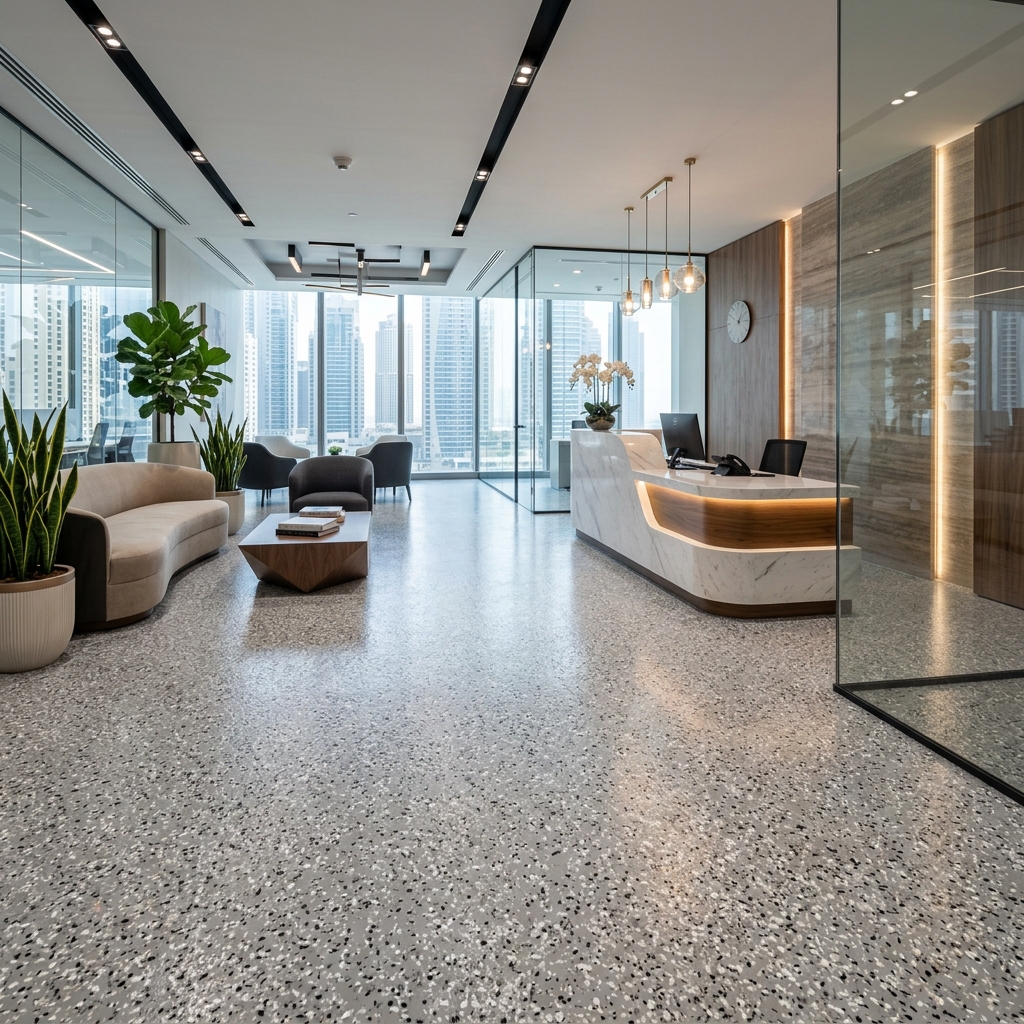
That combination — good looks plus practical toughness — is exactly why flake systems have become the go-to choice for garages, showrooms, and warehouse floors across Dubai. We’ll get into why the climate specifically favors this system a bit further down, but first, let’s talk about what “flakes” actually means, because there’s more variety here than most people expect.
Massive Savings Alert: Up to 40% Off on All Wholesale Orders!!
Types of Epoxy Flakes & Broadcast Styles
This is the part most flooring companies skip over, and it’s honestly the part that determines how your floor will look and perform. Not all flake floors are the same, and the choices you make here matter.
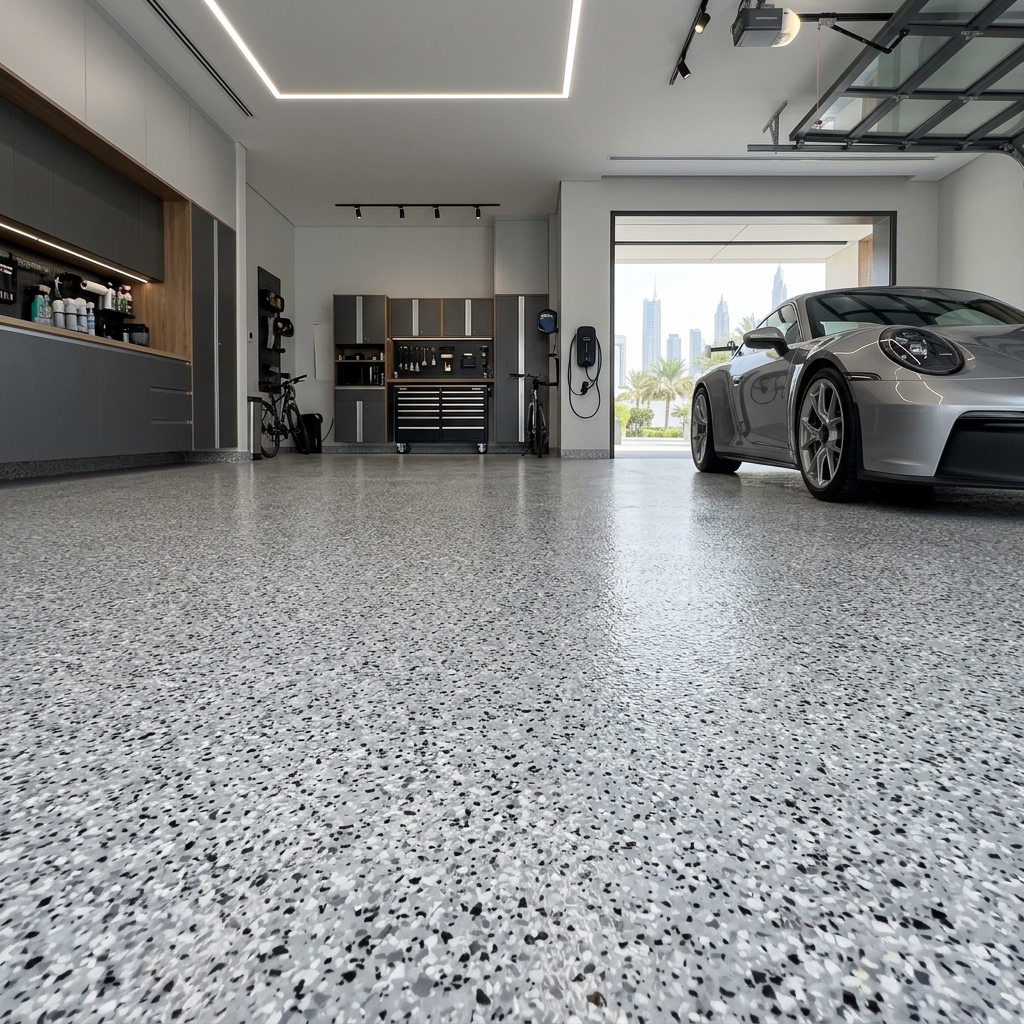
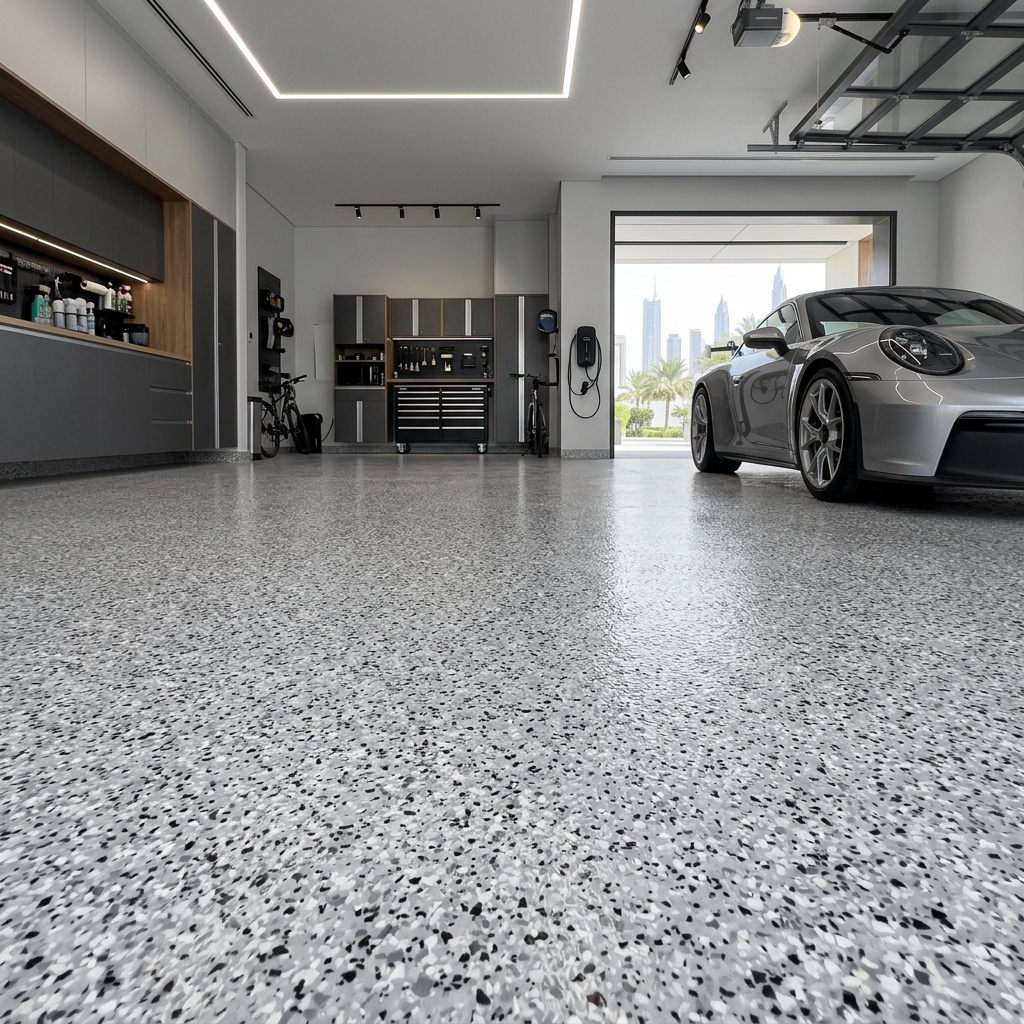
Flake size. Chips come in a few standard sizes — roughly 1/8″, 1/4″, and up to 1″ pieces. Smaller flakes give you a tighter, more subtle texture that reads almost like natural stone from a distance. Larger flakes create a bolder, more visible pattern with more grip underfoot. If you’re doing a villa garage where you want a clean, refined look, smaller flakes usually win. If it’s a warehouse floor where slip resistance matters more than subtlety, go bigger.
Broadcast method. There are two ways we apply the chips:
- Full broadcast — the surface is completely covered until no base coat shows through. This gives maximum texture, maximum durability, and the most uniform look. It’s the standard for commercial and industrial floors.
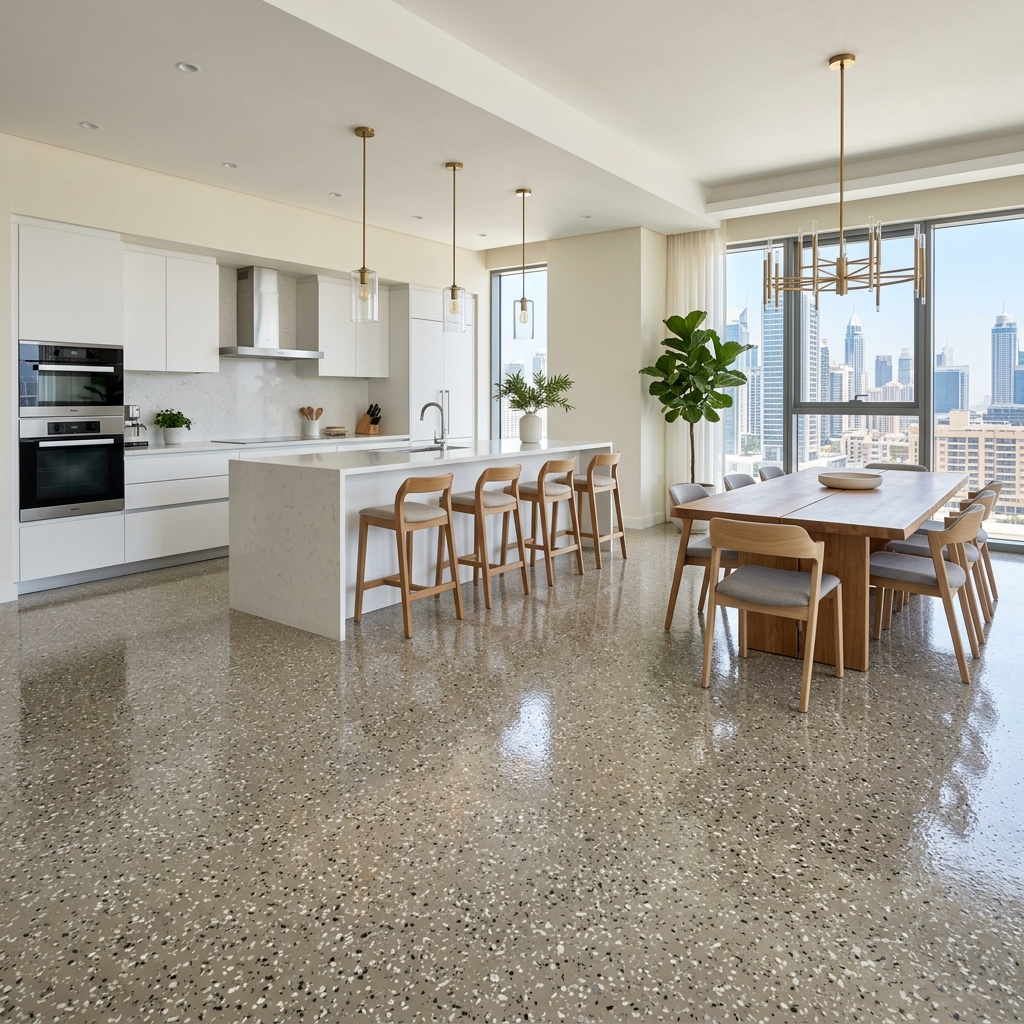
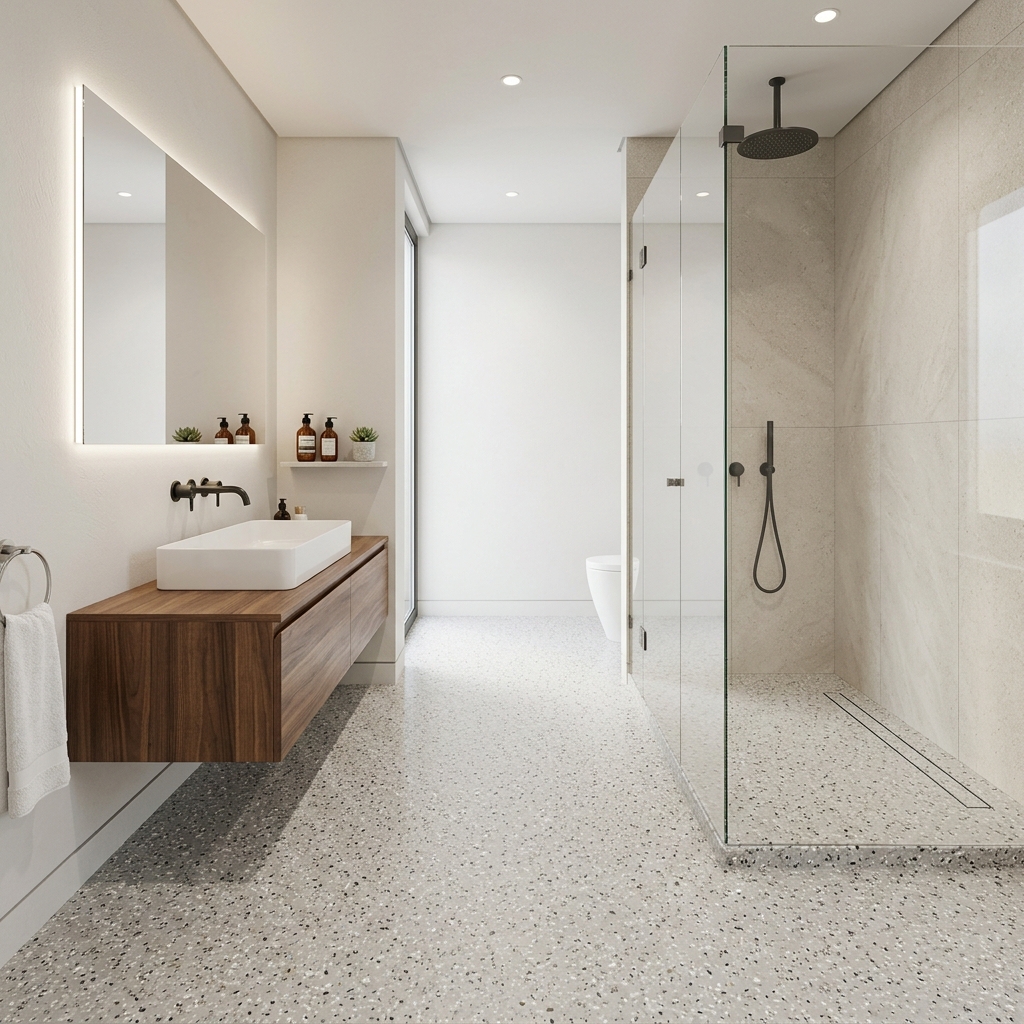
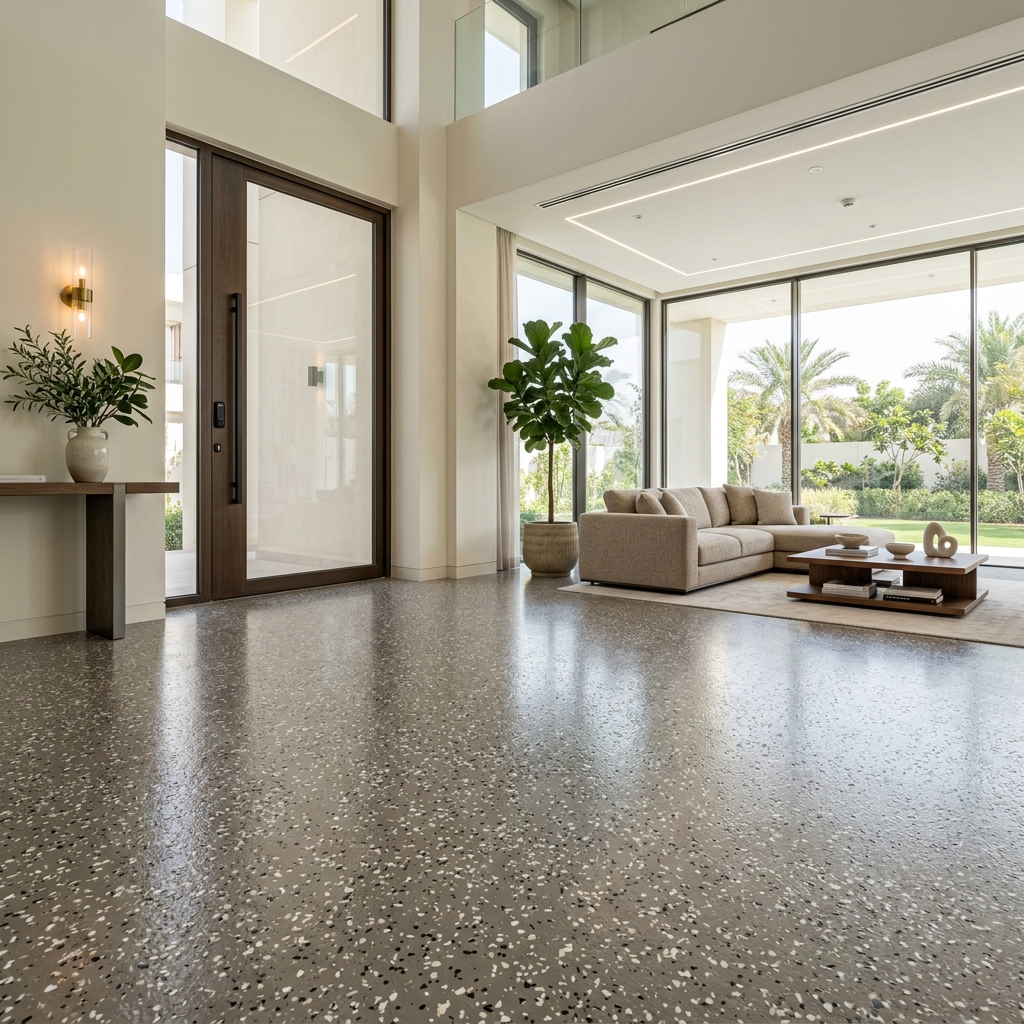
- Partial (or random) broadcast — chips are scattered more sparingly, letting the base color show through between them. This creates a lighter, more speckled effect that a lot of homeowners prefer for interior spaces where they want texture without it dominating the room.
Flake material. Vinyl chips are the most common — they’re UV-stable, come in a huge color range, and hold up well over time. Acrylic flakes offer a slightly different finish and are sometimes used for a more reflective look. Some systems mix in mica or metallic-flecked chips for a subtle shimmer within the texture, blending the flake and metallic aesthetics.
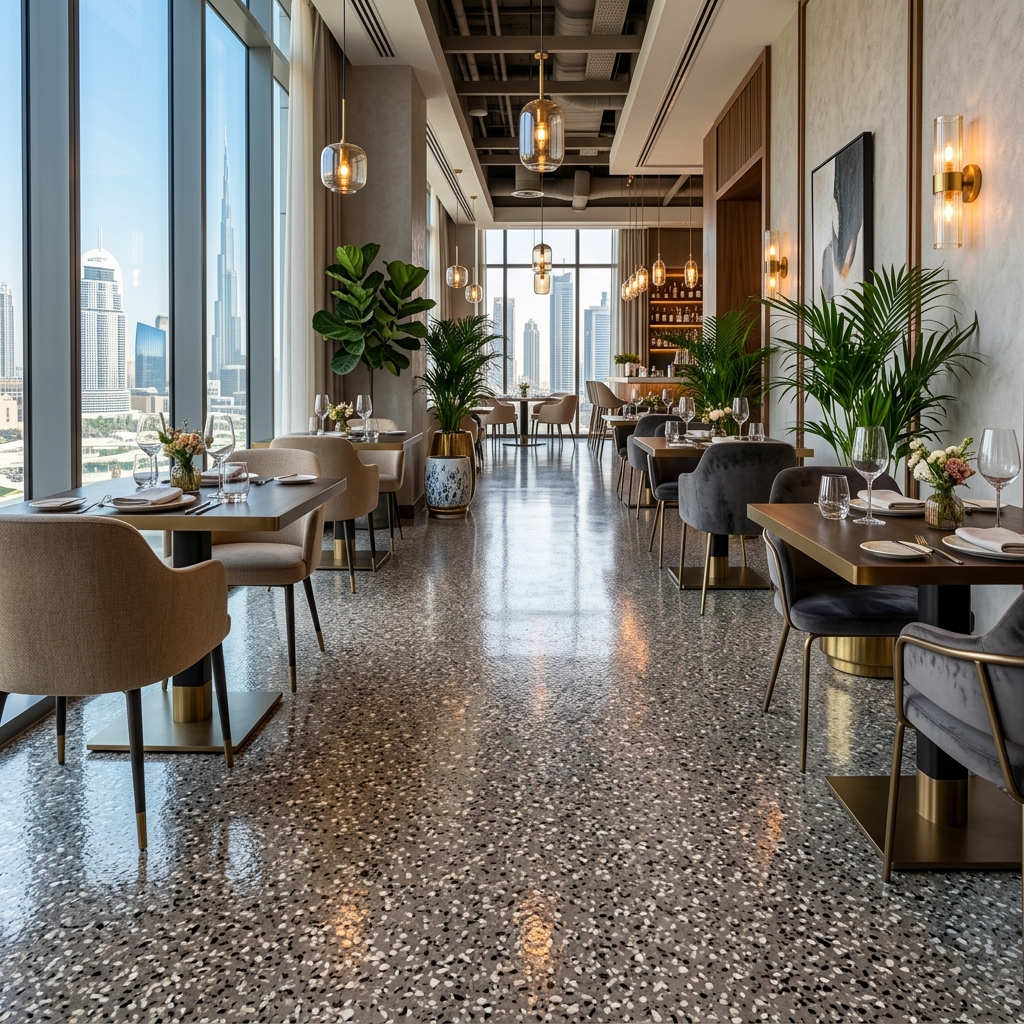
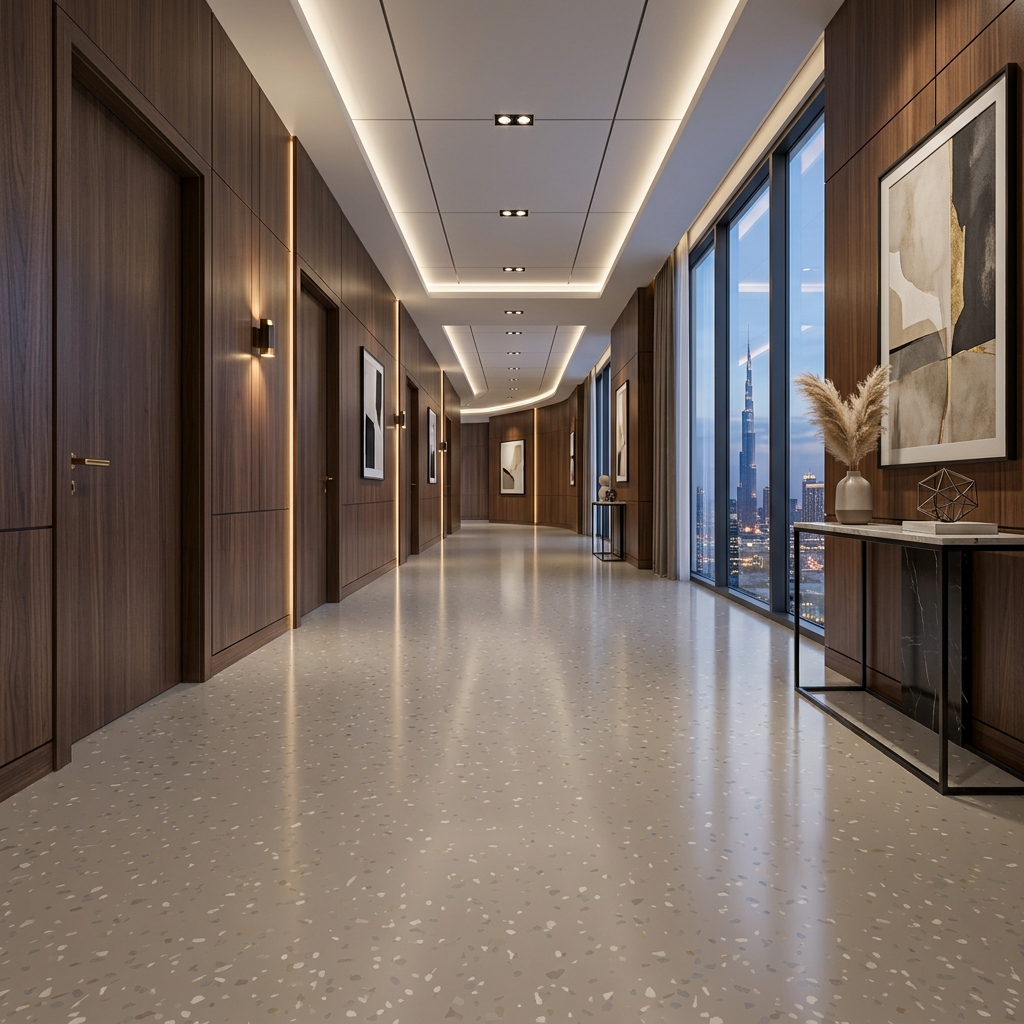
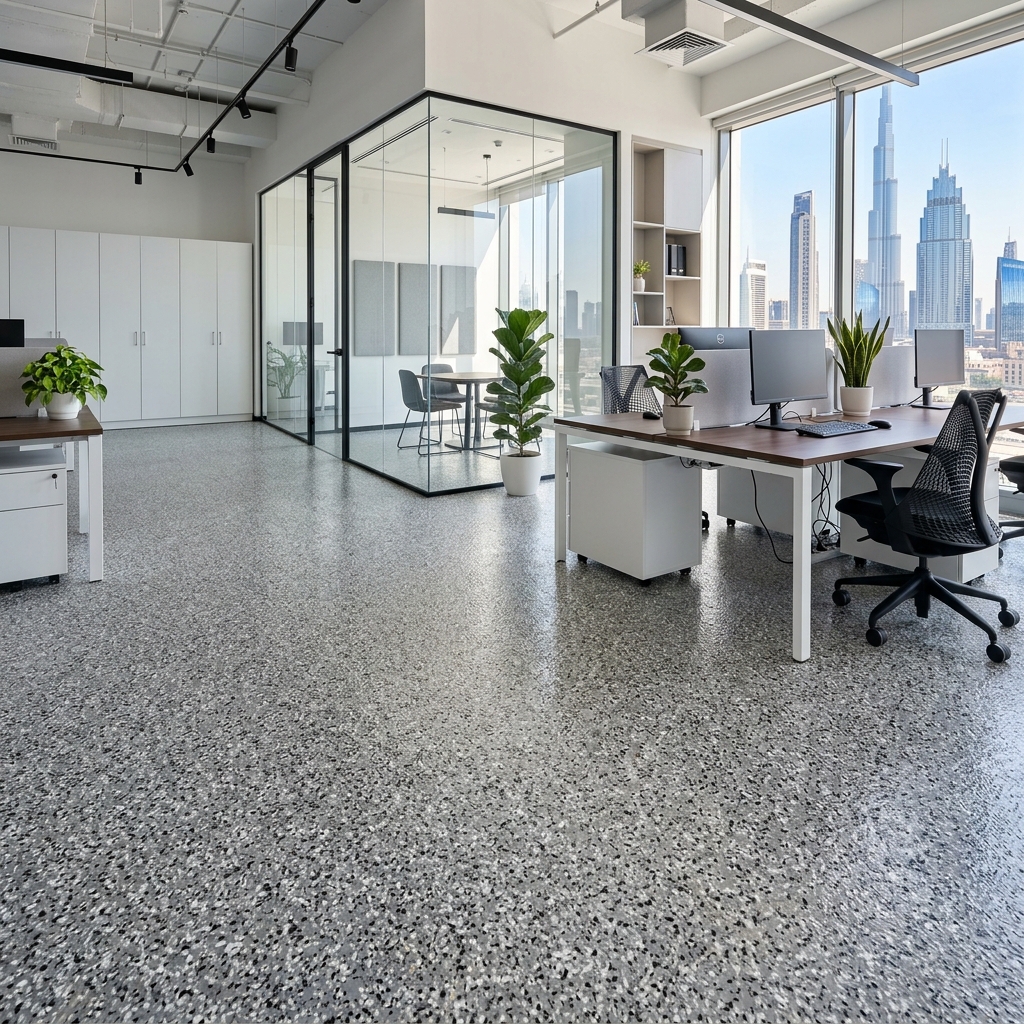
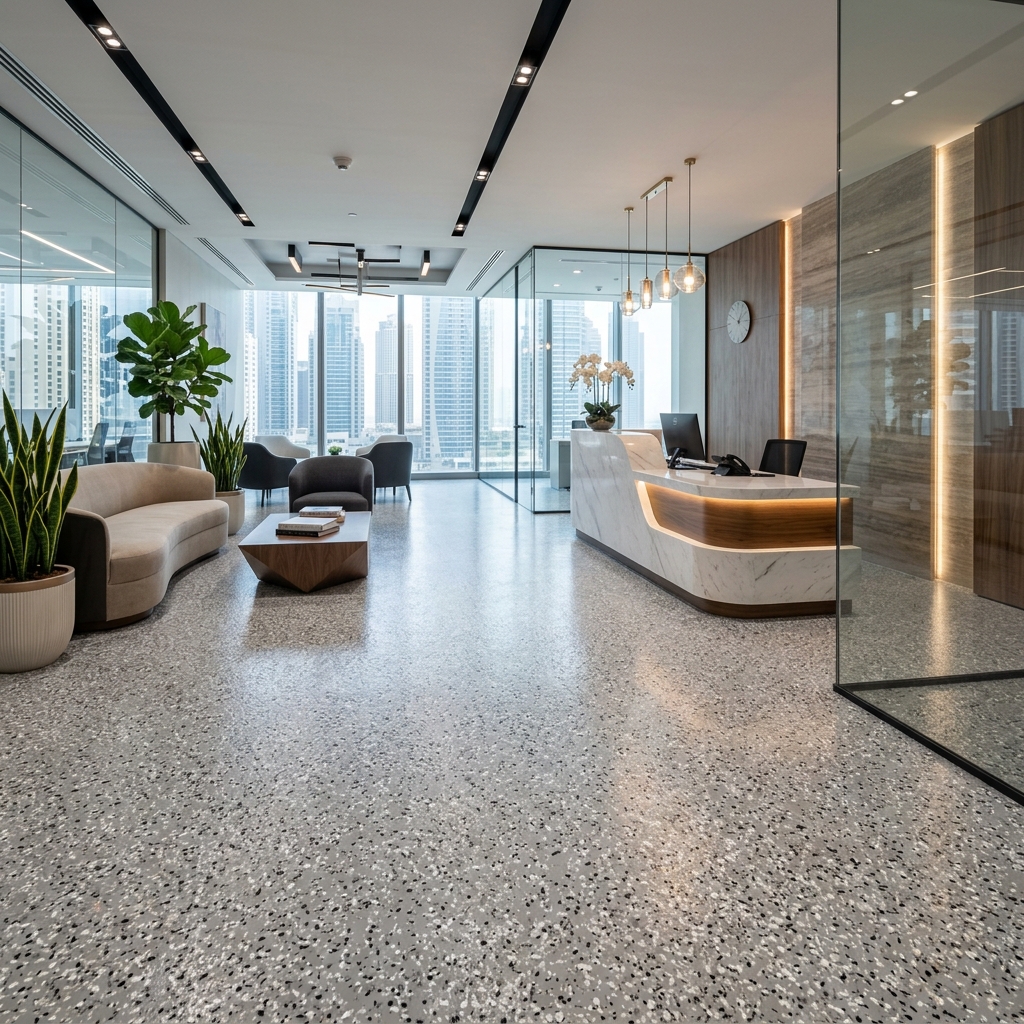
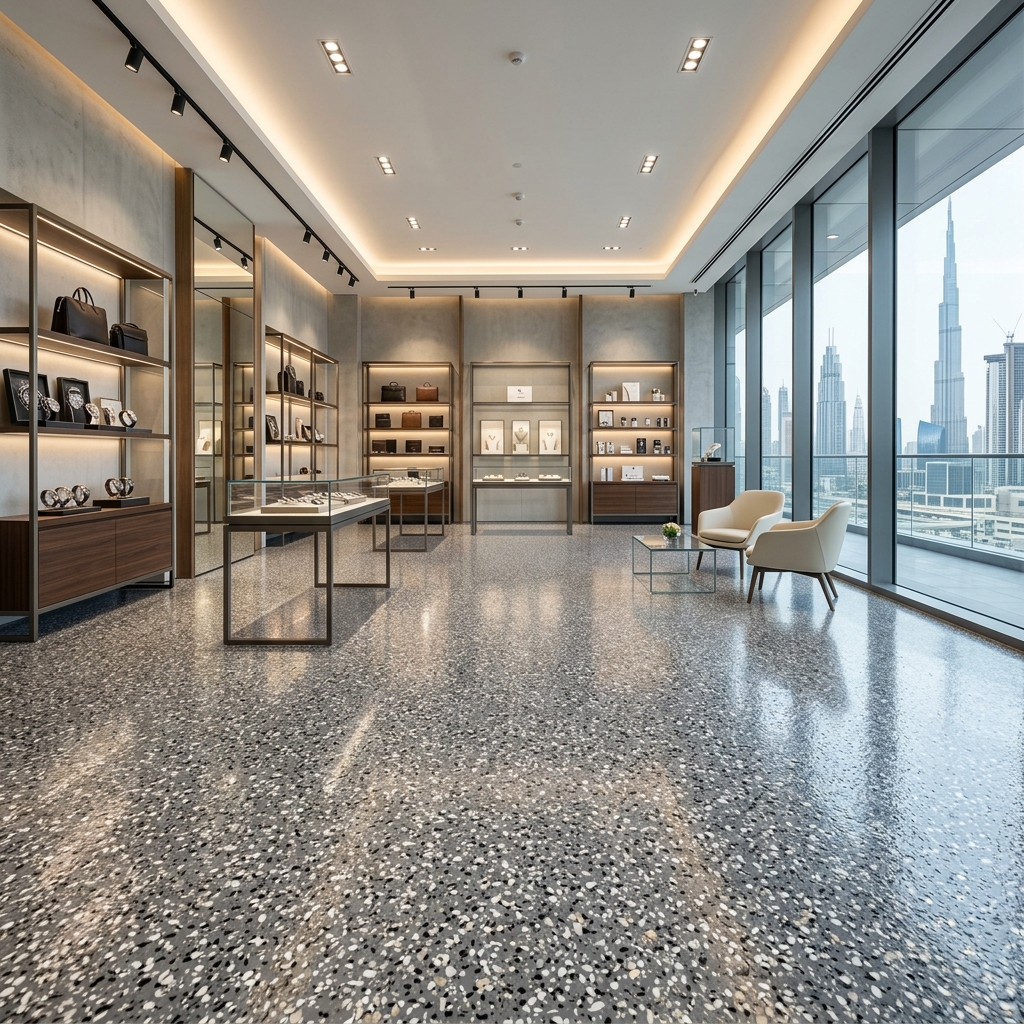
Color and blend. You can go monochrome for a clean, minimal look, or blend two to four colors for something with more visual movement — grey-and-black blends are popular for garages, while warmer multi-tone blends show up a lot in showrooms and retail spaces. If you’re working with a brand palette, we can custom-match flake blends to it.
A quick way to think about it: a villa garage often does well with a smaller flake, full broadcast, in a neutral two-tone blend. A showroom floor might use a lighter partial broadcast so the base color still reads through and photographs well under lighting. A warehouse usually wants full broadcast with a larger flake purely for the grip.
FREE INTERIOR DESIGN SERVICES FOR ALL OUR CUSTOMERS !!
Why Epoxy Flakes Flooring Works for Dubai's Climate
Dubai isn’t a gentle environment for floors. Between the sand that gets tracked in from outside, the heat, and the humidity swings, a lot of flooring options struggle here in ways they wouldn’t in a milder climate. Flake epoxy holds up better than most for a few concrete reasons.
It hides what Dubai throws at it. Fine sand and grit get walked in constantly, and on a smooth solid-color floor, every scratch from that grit shows up as a dull scuff mark over time. The textured, multi-tonal surface of a flake floor visually breaks that up — small scratches just blend into the pattern instead of standing out against a flat color.
It’s genuinely safer when wet. Pool decks, entrances during the rare but real rainy spells, and garages where cars drip condensation in humid months — these are places where a smooth floor becomes a hazard. The texture from the flakes gives real traction underfoot, wet or dry.
It resists UV better than people expect. A lot of homeowners worry about yellowing on floors that sit near glass — balconies, sunrooms, showroom windows with all-day sun exposure. Pairing flake systems with a polyurethane topcoat (rather than a standard epoxy topcoat) makes a real difference here; polyurethane holds its clarity and color far longer under UV than epoxy does on its own.
It handles heat better underfoot. Outdoor terraces and majlis areas get brutally hot in summer. The textured surface of a flake floor doesn’t retain and radiate heat in quite the same way a glass-smooth solid epoxy surface does, which matters if you’re walking on it barefoot.
None of this is marketing spin — it’s the practical reason flake systems dominate garage and outdoor installations across villas in communities like Arabian Ranches and Al Barsha, and why they’re the default choice for industrial floors in Al Quoz and the wider industrial zones.
Epoxy Flakes vs. Other Flooring Systems
If you’re still deciding between flakes, metallic, solid color, or quartz, here’s the honest breakdown:
| System | Durability | Slip Resistance | Cost/sqm | Best For |
|---|---|---|---|---|
| Flake Epoxy | High | High | Mid-range | Garages, warehouses, showrooms, high-traffic areas |
| Solid Epoxy | Medium-High | Low-Medium | Lower | Interiors wanting a clean, minimal single-tone look |
| Metallic Epoxy | Medium-High | Low | Higher | Statement floors — restaurants, reception areas, feature spaces |
| Quartz-Filled Epoxy | Very High | Very High | Higher | Commercial kitchens, medical facilities, extreme anti-slip needs |
Choose flakes over metallic if you need real grip and better concealment of daily wear — metallic looks stunning but scratches show more, and it offers no extra traction.
Choose flakes over solid color if the space sees real foot or vehicle traffic. Solid color looks great on day one, but every mark shows immediately. Flakes are built to age gracefully.
Choose quartz over flakes only in specific high-risk environments — commercial kitchens with grease on the floor, or medical spaces requiring the absolute highest slip resistance. For almost everything else, flakes give you the same durability without the added cost.
Epoxy Flakes Flooring Cost in Dubai
We’re not going to throw out a single number here and pretend every job costs the same, because that’s not honest — flake floor pricing depends on a few real variables.
What moves the price:
- Broadcast density — full broadcast uses more material and labor than partial broadcast, so it costs more per square meter.
- Flake size and blend complexity — a simple two-color blend is cheaper than a custom four-color match.
- Topcoat type — a standard epoxy topcoat costs less than a UV-stable polyurethane topcoat, but for outdoor or sun-exposed areas, the polyurethane pays for itself in longevity.
- Substrate condition — a garage floor with existing cracks or old coating needs more prep work (grinding, patching, moisture testing) before a flake system goes down, which adds to the cost.
What’s typically included in a standard quote: surface grinding, priming, the flake base coat and broadcast, and the topcoat. Common add-ons you might need depending on your floor’s condition: crack repair, a moisture barrier for ground-level slabs, or an anti-slip additive for extreme-traction areas.
Rather than quote a blanket price per square meter that won’t actually match your specific floor, we do a free site visit to check the substrate condition and give you an accurate number — a villa garage, a warehouse floor, and a showroom with a custom brand blend are three very different jobs, and your quote should reflect that.

Our Installation Process for Flake Epoxy Floors
A flake floor lives or dies by the prep work and the timing of the broadcast — this isn’t a system where you can rush steps and still get a good result. Here’s how we actually do it:
1. Grinding and moisture testing. We diamond-grind the existing concrete to remove old coatings, dirt, and surface contamination, and we test moisture levels in the slab. Skipping this is the number one reason epoxy floors bubble or peel later.
2. Crack repair and leveling. Any cracks, pits, or uneven patches get filled with epoxy filler and smoothed flat. A flake floor won’t hide structural imperfections in the concrete — it needs a level surface to start from.
3. Primer coat. This seals the concrete and gives the base coat something to properly bond to, which matters a lot for long-term adhesion in Dubai’s heat.
4. Base coat and flake broadcast. This is the step that separates a good flake floor from a mediocre one. The base coat has a limited “open time” — the window while it’s still wet enough for the chips to embed properly. Broadcast too early and flakes clump; too late and they don’t bond. This has to be timed and executed by hand, evenly, across the whole surface.
5. Scraping and sanding. Once the flakes have cured into the base coat, we scrape and sand the surface flat. This is a step some lower-quality installers skip to save time — and it’s obvious when they do, because the floor ends up with a rough, uneven texture instead of a smooth, sealed finish.
6. Topcoat and cure. The final protective layer goes on last. Flake floors typically need this topcoat applied a bit more generously than solid-color floors, since it has to fully seal over the raised texture of the chips, not just a flat surface.
Realistic timeline: for a standard residential floor, expect 1–2 days for prep, 2 days for the base coat and flake application, and 2–3 days for full curing — so budget roughly a week from start to a fully walkable floor. Larger commercial or industrial jobs take longer depending on square footage.

Epoxy Flakes Flooring Maintenance & Warranty
Flake floors are low-maintenance, but “low” doesn’t mean “none” — a bit of routine care goes a long way toward getting the full lifespan out of the floor.
Day-to-day: regular sweeping or a dry mop handles most dust and debris. Because of the texture, flake floors do trap slightly more fine dirt in the surface grooves than a glass-smooth solid epoxy floor, so a weekly damp mop with a mild, non-acidic cleaner keeps it looking new. Avoid citrus-based or vinegar cleaners — they can dull the topcoat over time.
What to avoid: dragging heavy furniture or equipment across the floor without protective pads, and pressure-washing at close range, which can wear down the topcoat prematurely.
Expected lifespan: with proper installation and normal care, residential flake floors typically last well over a decade, and commercial or industrial floors under heavier traffic generally hold up for 10+ years before needing a refresh coat.
Our warranty: [Insert your actual warranty terms here — years covered, and specifically what’s included, e.g., “5-year warranty covering peeling, bubbling, and delamination under normal use.” Vague warranty language is one of the biggest trust gaps in this industry — specific numbers here do real work.]
Frequently Asked Questions
What is epoxy flake flooring made of? It’s a resin and hardener base coat with decorative vinyl or acrylic chips broadcast into it while wet, sealed under a clear protective topcoat.
How much does epoxy flake flooring cost in Dubai? It depends on broadcast density, flake size, topcoat type, and your floor’s current condition. We recommend a free site visit for an accurate quote rather than a generic per-sqm number that won’t reflect your actual job.
Is epoxy flake flooring slippery when wet? No — the textured surface from the flakes gives it noticeably better grip than smooth solid-color epoxy, which is part of why it’s popular for pool decks, entrances, and garages.
How long does epoxy flake flooring last? Residential floors typically last well over 10 years with normal care; commercial and industrial floors under heavier use generally hold up for a decade or more before needing a refresh.
Can I choose the flake color and density? Yes. You can pick flake size, whether it’s a full or partial broadcast, and a color blend — including custom blends matched to a brand palette for commercial spaces.
How long does installation take? For a standard residential floor, plan for about a week total: 1–2 days of prep, 2 days for application, and 2–3 days of curing. Larger commercial or industrial floors take longer depending on size.
Does flake epoxy hide cracks and imperfections better than solid epoxy? It hides fine scratches and everyday wear far better, since the texture and multi-tone color break up the surface visually. It doesn’t hide structural cracks in the concrete though — those still need proper repair during prep.
Can flake epoxy be installed over existing tile or old epoxy? In many cases, yes, as long as the existing surface is properly ground, cleaned, and tested for adhesion. We assess this during the site visit before confirming.
Is epoxy flake flooring suitable for outdoor areas in Dubai’s heat? Yes, especially when paired with a UV-stable polyurethane topcoat, which resists the yellowing that standard epoxy topcoats can develop under prolonged sun exposure.
Get a Free Quote for Epoxy Flakes Flooring in Dubai
The best way to know exactly what your floor needs — and what it’ll actually cost — is a free site visit. We’ll check the substrate, talk through flake size and broadcast options that suit your space, and give you a real quote, not a rough guess.
[+971561850178]
[layaliinteriorsfze@gmail.com]
We typically respond within 24 hours and can schedule most site visits within the week.


